Career · Comparison
No-Code AI Tools vs Learning Python for AI: Which Path Is Right for You?
You can ship an AI demo with visual tools in an afternoon, or invest months learning Python for lasting control. Here is how no-code AI tools vs Python compare on speed, depth and career fit, plus a 60-second quiz to choose.
On this page

No-code AI vs Python: the real difference
No-code AI tools let you build with prompts, drag-and-drop flows or guided UIs instead of writing software. Examples include Google’s Teachable Machine for image, sound and pose models in the browser, Google AI Studio for trying Gemini models with prompts, and product builders such as Bubble AI or workflow tools like Zapier AI. You configure; the platform runs the model or automation.
Learning Python for AI means writing code to load data, train or call models, evaluate results and ship logic yourself. Python is the language most AI and data teams use for notebooks, libraries such as NumPy and scikit-learn, and production scripts. The official Python.org overview and docs are the baseline; Google’s Machine Learning Crash Course shows how that coding path usually looks.
So the no-code AI vs Python question is not “which is smarter?” It is where do you want the work to end: a configured demo inside someone else’s product, or code you can inspect, change and reuse when the product changes?
What each path actually teaches
No-code teaches problem framing, data collection, prompt design and product sense quickly. Python teaches those plus control: how features are built, how evaluation works, and how to fix failures that a UI cannot explain. Related reading: AI vs machine learning vs deep learning, generative AI vs data science and Python vs R.
No-code AI tools vs Python: side-by-side comparison
| Factor | No-Code AI Tools | Learning Python for AI |
|---|---|---|
| Time to first demo | Hours to a few days | Weeks to months for solid foundations |
| Main skill | Configure tools, prompts, flows | Write, test and debug code |
| Control | Limited to what the product exposes | High: custom logic, data and evaluation |
| Debugging | Often opaque; vendor logs and retries | You can inspect data, metrics and stack traces |
| Portability | Tied to the vendor UI and pricing | Skills transfer across libraries and jobs |
| Best for | Prototypes, internal tools, non-engineer builders | Custom models, pipelines, AI/ML careers |
| Typical ceiling | Great until you need a feature the tool lacks | Higher ceiling; steeper early climb |
| Pairing tip | Validate the idea first | Productionise and customise later |
Qualitative comparison based on public product docs for Teachable Machine, Google AI Studio, Bubble AI and Zapier AI, plus Python.org and Google’s ML Crash Course. Tool features change; always check the vendor page. No salary or job-count figures.
Path split: ship a demo vs own the logic
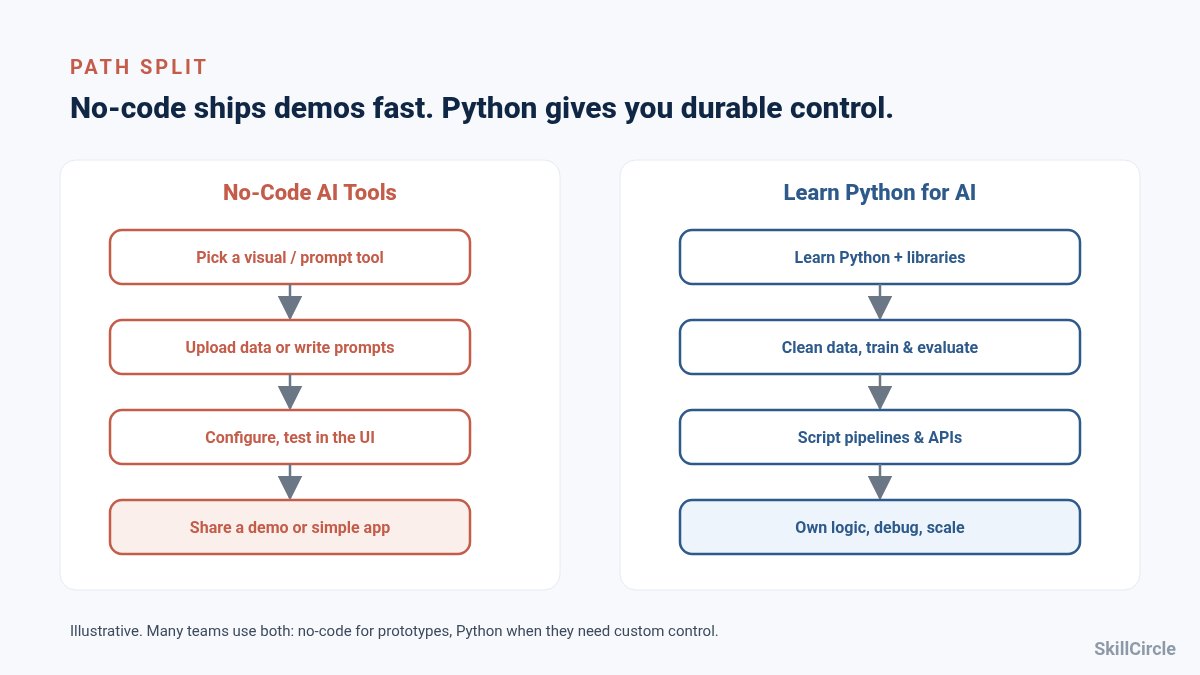
Think of a relay. No-code gets the idea into a shareable form so stakeholders can react. Python takes over when you need reproducible training, custom features, APIs or evaluation that the UI does not offer. For agent-style systems that go beyond a single chat box, see AI agents vs chatbots. For retrieval and model adaptation trade-offs, see RAG vs fine-tuning.
Did you know? Teachable Machine runs image, audio and pose experiments in the browser without installing a stack. Google AI Studio is built for trying Gemini models with prompts before you wire them into an app. Neither replaces learning how models are trained and evaluated if that is your career goal.
When each path wins
Tap a scenario to see which path usually fits.
I need a stakeholder demo this week
No-code first. Use a prompt playground, Teachable Machine-style trainer or a workflow tool to show the idea. Add Python later if the demo becomes a product.
I want an AI / data science job
Python. Employers expect coding for data work, modelling and debugging. Pair it with SQL basics; see SQL vs Python for data analysis.
I am in marketing or ops, not engineering
Start no-code. Learn to brief, evaluate and automate with AI tools. Add light Python only if you outgrow the tools.
Our model quality is stuck and the UI will not say why
Python (or a technical teammate). Opaque failures are a classic no-code ceiling. You need inspectable data, metrics and code.
We need a custom pipeline that runs every night
Python. Scheduled jobs, custom transforms and tests are code territory. No-code workflows help for simple triggers, not complex ML ops.
I am curious about AI but scared of syntax
No-code as on-ramp, Python as destination. Build intuition with visual tools, then learn Python with a structured course so the syntax has a purpose.
Quiz: which path is right for you?
Answer five quick questions about the work you want. It is a rule of thumb, not a hiring decision.
Best fit by background
Switch tabs to see what matters for you.
- Shared start: try one no-code demo so AI feels concrete, then commit to Python basics.
- If you want AI/DS roles: Python is not optional long-term. See ML engineer vs data scientist.
- Portfolio tip: one Teachable Machine-style experiment plus one Python notebook beats ten disconnected tutorials.
- Course options: Masters in Data Science or classroom DS in Noida.
- Natural start: no-code and GenAI tools for your domain (reports, support, marketing workflows).
- Add Python if: you repeatedly hit tool limits or want a technical pivot.
- Course options: Generative AI course and online vs classroom data science.
- Time tip: schedule short daily practice; binge weekends fade fast.
- Natural path: Python for AI. You already think in logic, tests and APIs.
- Use no-code for: stakeholder demos and rapid prompt experiments, not as a substitute for engineering.
- Add: ML evaluation, data quality and deployment basics.
- Course: AI course in Connaught Place.
Pros and cons
Flip between the upsides and the trade-offs.
No-Code AI Tools
- Fastest path from idea to shareable demo
- Low barrier for non-engineers
- Great for learning AI concepts by doing
- Vendor lock-in and opaque failures
- Harder to customise evaluation and pipelines
- Skills may not transfer when the product changes
Learning Python for AI
- Deep control over data, models and logic
- Skills travel across libraries and employers
- Required for most serious AI / data roles
- Steeper early learning curve
- Slower time to a polished demo
- Needs deliberate practice, not only watching videos
Skills checklist
Three questions that decide it
- Do you need a demo this month or a career skill this year? Demo leans no-code; career depth leans Python.
- Will you accept a vendor ceiling? If no, plan for code.
- What will you practise weekly? Tool workflows, or Python + one modelling project?
Tick the skills you already have or want soon
Tick items honestly, then use the gaps as a learning plan. Mix is normal.
Learn AI and Python skills with SkillCircle
Builder / GenAI path: the Generative AI course and the AI course in Connaught Place lean toward modern AI systems and practical building. Comparing programme types? Read generative AI vs data science.
Python / data science path: the Masters in Data Science covers the coding foundations AI roles expect. Prefer classroom? See the data science course in Connaught Place or data science in Noida. Format still open? Read online vs classroom data science.
SkillCircle has trained 74,356+ learners since 2016, across 15+ centres in 10 states, with a network of 750+ hiring partners and placement support. It was named Best Vocational Institute 2026 by Entrepreneur India. Fees vary by programme and centre; ask a counsellor for exact fees and batch dates.
Generative AI course Masters in Data Science
Find more comparisons and guides on the SkillCircle blog.
FAQs: no-code AI vs Python
What is the difference between no-code AI tools and learning Python for AI?
No-code AI tools let you configure prompts, visual trainers or workflows inside a product UI so you can ship demos without writing software. Learning Python for AI means writing code to prepare data, train or call models, evaluate results and automate pipelines. No-code wins on speed; Python wins on control and transferable skill.
Should beginners start with no-code or Python?
If you need a quick win or are non-technical, start with a no-code demo so AI feels concrete. If your goal is an AI, data science or ML role, begin Python early and use no-code only as a sketch pad. Many people do a short no-code project first, then commit to a structured Python path.
Can no-code AI replace learning Python?
For simple internal tools and demos, sometimes yes. For custom models, debugging, evaluation and most AI hiring bars, no. Product UIs change; Python skills transfer. Treat no-code as complementary, not a full substitute, if you want a technical career.
Which no-code AI tools are useful to try first?
Public starting points include Google Teachable Machine for browser-based image, sound and pose experiments, Google AI Studio for Gemini prompt trials, and product/workflow tools such as Bubble AI or Zapier AI for app and automation prototypes. Always check the vendor’s current docs and limits.
How long does it take to learn Python for AI?
Enough Python to be useful for data and classical ML usually takes months of consistent practice, not a weekend. Exact timelines depend on your background. A structured course with projects beats scattered tutorials. Pair Python with basic statistics and one end-to-end project.
Which SkillCircle programme matches each path?
Lean GenAI / builder: the Generative AI course or the AI course in Connaught Place. Lean Python and modelling foundations: Masters in Data Science or a classroom data science programme. Talk to a counsellor to match modules to your background; SkillCircle offers placement support, not a job guarantee.
Sources
- Google Teachable Machine: teachablemachine.withgoogle.com (browser-based no-code model experiments).
- Google AI Studio: aistudio.google.com (prompt-based Gemini experimentation).
- Bubble AI: bubble.io/ai; Zapier AI: zapier.com/ai (no-code app and workflow AI features).
- Python.org: About Python and documentation.
- Google for Developers: Machine Learning Crash Course.
- SkillCircle course pages checked 6 Nov 2026: Generative AI, Masters in Data Science, AI Connaught Place.
Ready to choose your AI learning path?
Talk to a counsellor about your background and ask which modules match no-code builders versus Python-first AI skills.
Generative AI courseMasters in Data Science