
Data analytics · Learning guide
SQL vs Python for Data Analysis: Which Should You Learn First?
SQL gets the data out of the database. Python cleans, analyses and automates it. Here’s what each one is really for, which to learn first for your goal, and how the two fit together.
On this page
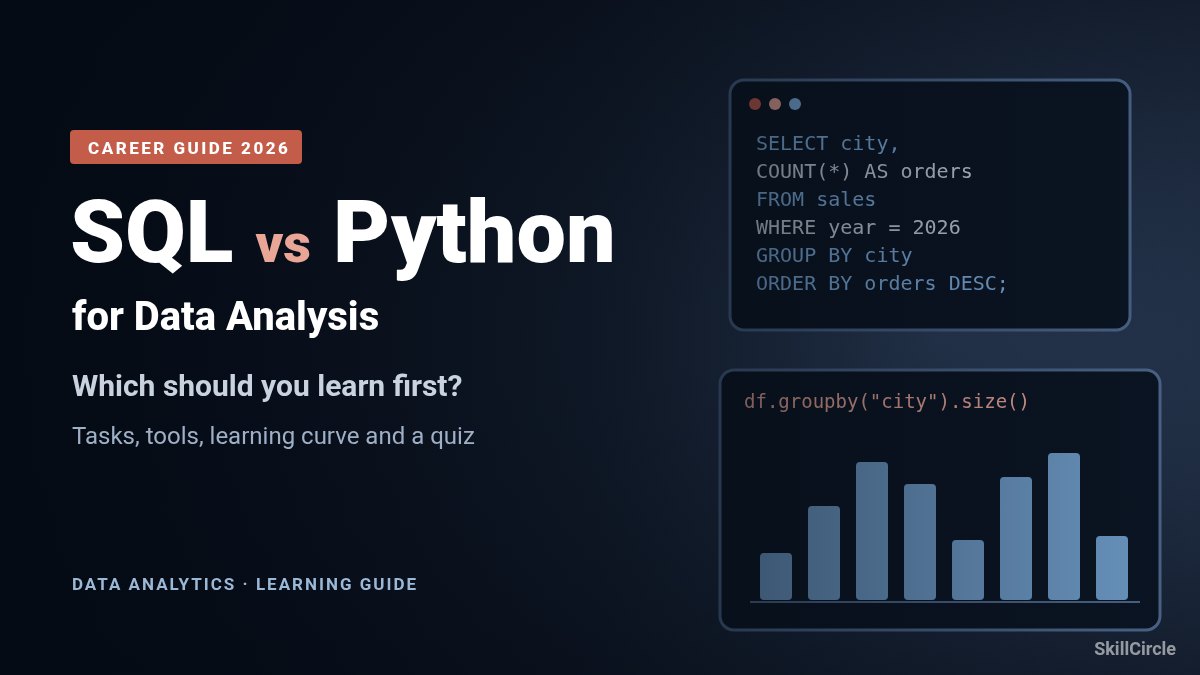
SQL vs Python for data analysis: the real difference
SQL (Structured Query Language) is the standard language for working with data stored in relational databases; it is defined in the international standard ISO/IEC 9075. You use it to ask a database for exactly the rows, columns and totals you need. Python is a general-purpose programming language. For data analysis you use it with libraries such as pandas, NumPy and Matplotlib to clean, reshape, analyse, visualise and automate work on data from almost any source.
So the SQL vs Python for data analysis question is less “which is better?” and more “which job comes first?”. SQL is how you get and summarise data where it lives. Python is how you do more with it once you have it.
Where they overlap
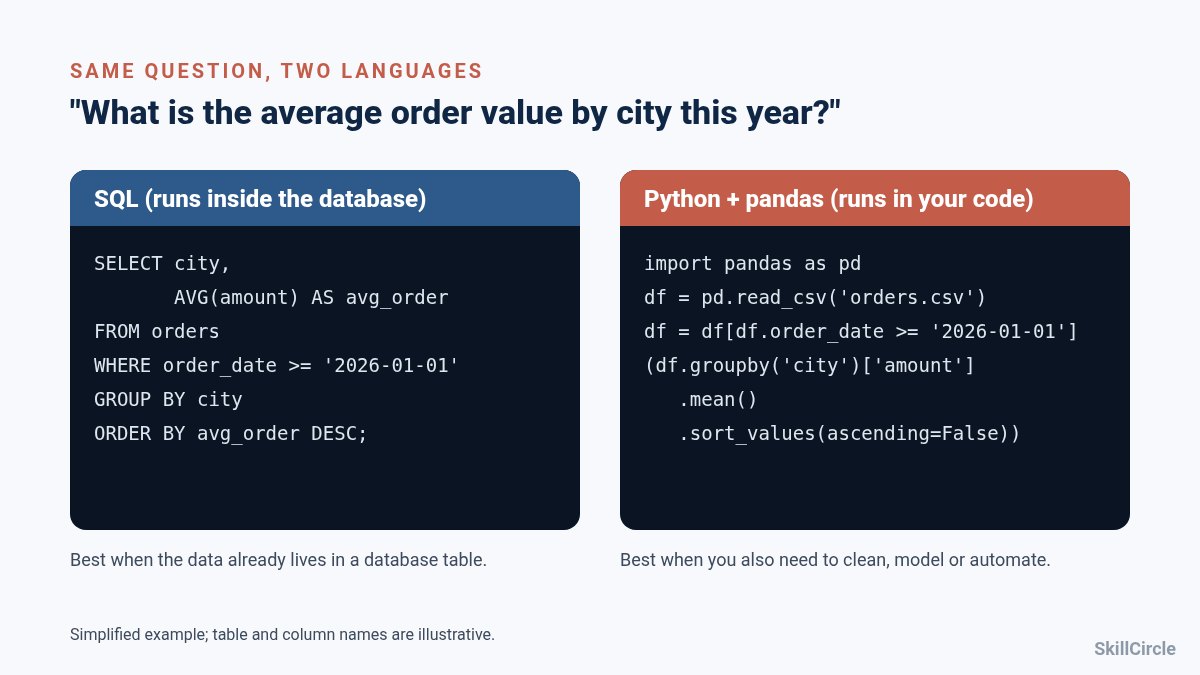
A lot of everyday analysis can be done in either: filtering, grouping, joining and sorting. The pandas project even publishes a comparison with SQL that maps SQL statements like WHERE, GROUP BY and JOIN to their pandas equivalents. And they work together: Python can send SQL to a database, for example with its built-in sqlite3 module.
Why the order matters
SQL is a smaller, declarative language: you describe the result, the database works out how to get it. That is why many beginners write useful queries early on. Python asks you to learn programming basics first, but it opens up statistics, automation and machine learning. If you’re still choosing a first programming language for data work, see Python vs R for data science.
SQL vs Python: side-by-side comparison
| Factor | SQL | Python (with pandas) |
|---|---|---|
| What it is | A query language for relational databases | A general-purpose programming language |
| Main job in analysis | Pull, filter, join and aggregate data where it is stored | Clean, reshape, analyse, visualise and automate |
| Style | Declarative: describe the result you want | Step-by-step code: variables, functions, libraries |
| Learning curve for beginners | Gentler start; core commands are few | Steeper start; more concepts before you’re productive |
| Typical data | Tables in MySQL, PostgreSQL, SQL Server, cloud warehouses | CSV, Excel, JSON, APIs, web data, plus database tables |
| Large data | Runs inside the database, so large tables are handled there | Works in your computer’s memory unless you use extra tools |
| Statistics and ML | Basic aggregates only | Full statistics and machine learning (SciPy, scikit-learn) |
| Charts | None by itself; feeds BI tools like Power BI and Tableau | Matplotlib, seaborn, Plotly |
| Automation | Limited (scheduled queries, views) | Strong: scripts, reports, emails, pipelines |
| Best first for | Data analyst, MIS, BI and reporting roles | Data science, ML and automation-heavy roles |
General comparison. Exact tools vary by company; check the job descriptions for the roles you want.
How widely SQL and Python are used
Both are among the most used languages in the world. In Stack Overflow’s 2025 Developer Survey, SQL (58.6%) and Python (57.9%) were the third and fourth most-used languages among all respondents, behind only JavaScript and HTML/CSS. Stack Overflow noted that Python’s use jumped 7 percentage points from 2024 to 2025, which it linked to AI, data science and back-end work.
Share of all respondents who did extensive work in each language that year. Source: Stack Overflow Developer Survey languages time series. Respondents are mostly developers, not only analysts.
The takeaway for learners: you’re not choosing a niche skill with either one. The two lines move together, which is another sign they are used side by side.
Which tool for which task
Tap a task to see which tool usually fits best.
Pull last month’s sales by region from the company database
SQL. A SELECT with WHERE and GROUP BY runs inside the database and returns only the summary you need.
Combine customer, order and product tables
SQL, with JOINs. Python can join too, but it is usually faster and simpler to join where the data lives.
Feed a Power BI or Tableau dashboard
SQL to shape the dataset, then the BI tool to visualise it. Not sure which BI tool? Read Power BI vs Tableau.
Clean 40 messy Excel files from different branches
Python. A short pandas script can read every file, fix columns and combine them, and you can re-run it next month.
Test whether a campaign really lifted sales
Python, for statistical tests (for example with SciPy). SQL can prepare the numbers first.
Predict which customers may stop buying
Python, with machine learning libraries like scikit-learn. This is data science territory; see data analyst vs data scientist.
Send the same report every Monday
Both: SQL to get the data, Python to build and send the report automatically.
Quiz: SQL or Python first?
Answer five quick questions. It’s a rule of thumb, not a final verdict.
Who should start where
Switch tabs to see the usual starting point for your situation.
- Usual start: SQL, then Python.
- Why: SQL gives you a job-ready skill early, and practising queries builds the logical thinking that makes Python easier.
- Then: add Python with pandas, and a BI tool for dashboards.
- Career fit: unsure which data role suits you? Read data analyst vs data scientist.
- Usual start: SQL.
- Why: if you already sort, filter and pivot in Excel, SQL feels familiar: GROUP BY is a pivot table, a JOIN is a smarter VLOOKUP.
- Then: Power BI or Tableau for dashboards, and Python when you want to automate repeated work.
- Near Delhi NCR? Compare options in our data analytics course in Delhi NCR guide.
- Usual start: Python, with SQL added early.
- Why: statistics and machine learning are done in Python, so you’ll use it every day.
- Don’t skip SQL: real projects start by pulling data from a database.
- Next decision: if you’re also weighing LLM work, see generative AI vs data science.
Pros and cons
Flip between the upsides and the trade-offs.
Learning SQL first
- Small set of core commands
- Useful at work almost straight away
- Same core skills across MySQL, PostgreSQL and SQL Server
- Not a full programming language
- No statistics, ML or charts on its own
- Small syntax differences between databases
Learning Python first
- One language for cleaning, analysis, charts and ML
- Strong for automation and messy data
- Leads naturally into data science and AI
- Steeper start for non-coders
- Setup (libraries, notebooks) can confuse beginners
- You still need SQL to get company data
SQL skills checklist: are you ready to add Python?
Three questions that decide it
- Where is your data? In databases points to SQL first; in files and APIs points to Python.
- What’s your target role? Analyst and BI roles lean SQL; data science leans Python.
- Do you need automation? If you repeat the same work every week, Python pays off fast.
Tick the SQL skills you already have
If you tick 5 or more, you’re ready to add Python. Fewer than 4? Keep practising SQL first.
Learn SQL and Python for data analysis with SkillCircle
Data analytics: our Data Analytics course in Connaught Place (the Skill Degree in Data Analytics) runs for four months of live classes covering Excel, statistics, Python, SQL (MySQL), Power BI and Tableau in one track, with classroom and live online batches. You can also join at our centres in Noida, Gurugram and Hyderabad.
Data science: if you’re heading for machine learning, the Masters in Data Science is a 6-month live programme with classroom batches at centres including Connaught Place, plus live online batches. Fees vary by programme and centre; ask a counsellor for the exact fee and batch dates.
SkillCircle has trained 74,356+ learners since 2016, across 15+ centres in 10 states, with a network of 750+ hiring partners. It was named Best Vocational Institute 2026 by Entrepreneur India.
Data Analytics course Masters in Data Science
Find more comparisons and guides on the SkillCircle blog.
FAQs: SQL vs Python for data analysis
Should I learn SQL or Python first for data analysis?
For most beginners aiming at data analyst or business intelligence roles, SQL first. It is a smaller language, you see results straight away, and most company data sits in databases that you query with SQL. Learn Python first if your goal is data science or machine learning, or if your data mostly arrives as files, APIs or messy text that needs automation.
Is SQL easier than Python?
For data analysis, most learners find SQL quicker to start because it is declarative: you describe the result you want (which rows, which columns, which totals) and the database works out how to get it. Python is a general-purpose programming language, so there is more to learn, such as variables, loops, functions and libraries like pandas, before you are productive.
Can I do data analysis with only SQL?
You can do a lot: filtering, joining tables, aggregating, window functions and building the datasets behind dashboards. Many analyst roles pair SQL with Excel and a BI tool such as Power BI or Tableau. You will hit limits with statistics, machine learning, automation and messy file formats, which is where Python helps.
Can Python replace SQL?
Not really. Python libraries like pandas can do the same filtering, grouping and joining (the pandas documentation even has a ‘comparison with SQL’ guide), but company data usually lives in databases, and SQL is how you pull it out efficiently. In practice analysts use both, and Python can run SQL directly, for example through its built-in sqlite3 module.
Do data analysts need Python?
Many analyst roles ask for SQL, Excel and a BI tool first, with Python as a plus. Python becomes more important as you move towards automation, statistics, larger or messier datasets, and data science roles. Check the job descriptions for the roles you want and note how often each skill appears.
Do I need SQL for data science?
Yes. Data scientists spend much of their time getting and preparing data, and that data usually comes from databases. SQL is a core skill in most data science courses alongside Python, statistics and machine learning.
Which SQL database should I practise on?
Any mainstream one is fine, because the core SQL you learn (SELECT, WHERE, GROUP BY, JOIN) is shared across MySQL, PostgreSQL, SQLite and SQL Server. SQLite needs no server and works from Python, so it is an easy start; MySQL and PostgreSQL are common in jobs and courses.
Sources
- Stack Overflow: 2025 Developer Survey, Technology and languages time series (2026 edition).
- pandas documentation: Comparison with SQL.
- Python documentation: sqlite3, DB-API 2.0 interface for SQLite databases.
- ISO: ISO/IEC 9075-1:2023, Database languages SQL, Part 1: Framework.
- SkillCircle course pages: Data Analytics course in Connaught Place, Masters in Data Science (checked 30 Oct 2026).
Still deciding between SQL and Python?
Talk to a counsellor about your background and the roles you want, and ask to see how the course moves from SQL to Python.
Data Analytics courseMasters in Data Science