
What is Traditional Marketing?
The traditional marketing vs digital marketing debate is one of the most common questions business owners and students ask. Before understanding the difference between traditional marketing and digital marketing, you need to know what each one actually means in practice.
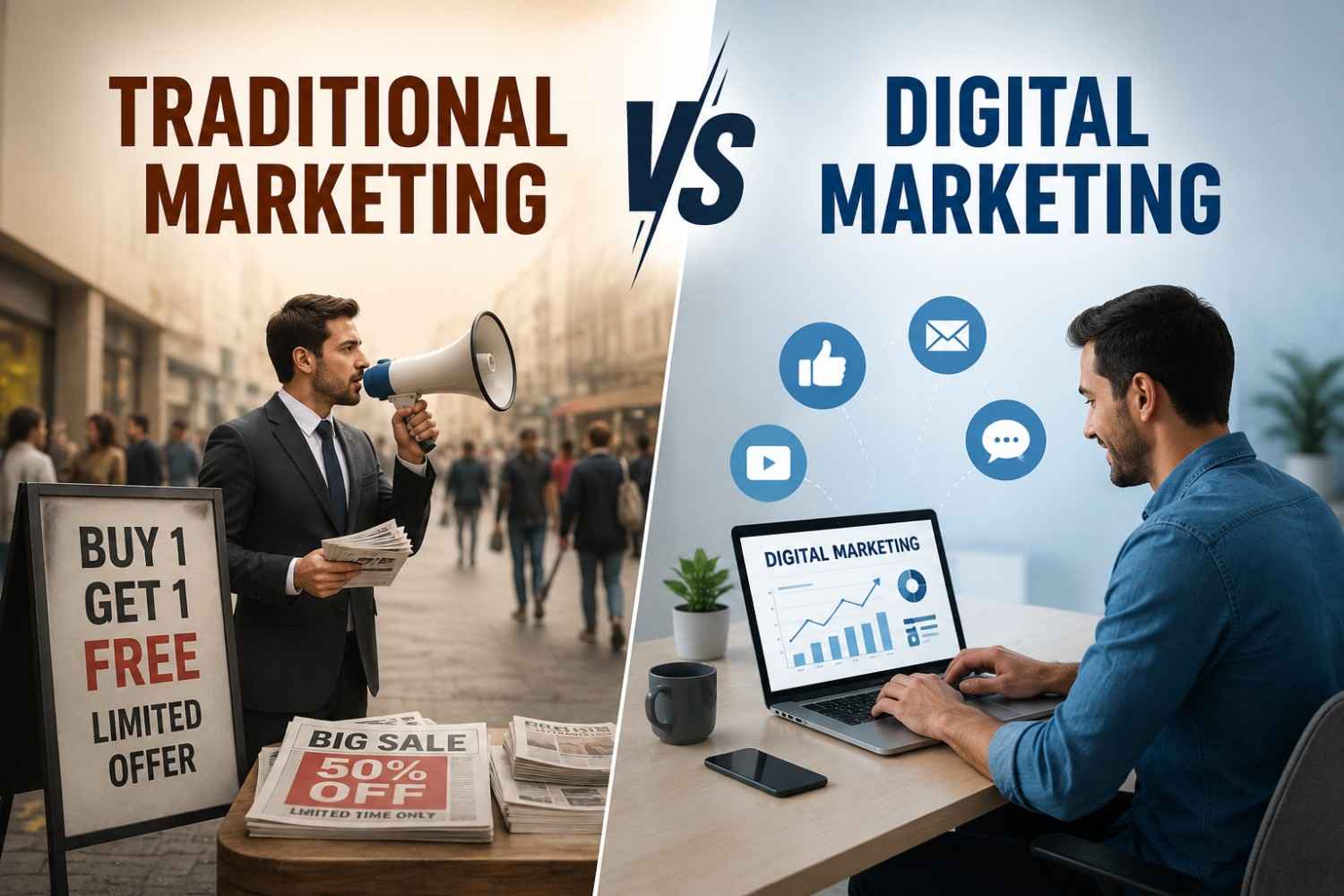
Traditional marketing refers to any promotional method that uses offline channels to reach an audience. It existed long before the internet and is still used today. When you see a hoarding on a highway, get a pamphlet in your apartment complex, hear an ad on the radio, or watch a commercial during a cricket match on television — that is traditional marketing.
The core channels of traditional marketing include:
- Print media — Newspapers, magazines, brochures, pamphlets
- Broadcast media — Television commercials, radio spots
- Outdoor advertising — Billboards, hoardings, transit ads on buses and autos
- Direct mail — Postcards, catalogues sent to homes or offices
- Event marketing — Sponsorships, trade fairs, exhibitions
- Telemarketing — Cold calling potential customers directly
The defining characteristic of traditional marketing is that it is one-way communication. The brand pushes a message out to a broad audience. The audience receives it passively. There is no direct interaction, no real-time feedback, and very limited ability to track whether the message actually worked.
What is Digital Marketing?
Digital marketing is the promotion of products, services, or brands through online channels. It uses the internet, mobile devices, social media platforms, search engines, email, and websites to reach and engage audiences. Understanding this is central to understanding both the traditional marketing vs digital marketing debate and the difference between traditional marketing and digital marketing in practice.
The core channels of digital marketing include:
- Search Engine Optimisation (SEO) — Getting your website to rank on Google
- Search Engine Marketing (SEM / Google Ads) — Paid ads on search results
- Social Media Marketing — Instagram, Facebook, LinkedIn, YouTube
- Content Marketing — Blog posts, videos, infographics that attract audiences
- Email Marketing — Newsletters, promotional emails, automation sequences
- Meta Ads / Display Ads — Paid ads across social platforms and websites
- Affiliate Marketing — Revenue sharing with partners who promote your brand
The defining characteristic of digital marketing is that it is two-way and measurable. You can see who saw your ad, who clicked it, who bought something because of it, and what the cost per result was. You can adjust your campaign the same day if something is not working. This level of control is the core of the difference between traditional marketing and digital marketing that most businesses care about.
, digital advertising accounts for over 74% of global ad spend according to Statista — meaning the majority of marketing budgets worldwide have already shifted online.
Traditional Marketing vs Digital Marketing — Key Differences
Here is a complete side-by-side comparison of traditional marketing vs digital marketing — covering every factor that matters for understanding the difference between traditional marketing and digital marketing:
| Factor | Traditional Marketing | Digital Marketing |
|---|---|---|
| Medium | Offline — TV, print, radio, billboards | Online — search, social, email, websites |
| Reach | Local or regional by default | Local, national, or global — your choice |
| Targeting | Broad — all viewers of a channel or readers of a paper | Precise — by age, location, interest, income, behaviour |
| Cost structure | Large fixed upfront cost | Flexible — start from ₹300/day |
| Measurability | Difficult — estimated impressions | Exact — clicks, conversions, cost per lead tracked |
| Speed | Slow — weeks to plan and execute | Fast — launch a campaign the same day |
| Adjustability | Low — reprinting or rebooking costs money | High — pause, edit, or scale in real time |
| Interaction | One-way — brand speaks, audience listens | Two-way — audience can comment, share, respond |
| ROI tracking | Very difficult — estimates only | Very precise — every rupee tracked |
| Shelf life | Short — ad runs once, then it is over | Long — a blog post or video can generate traffic for years |
| Best for | Broad awareness, local trust, older demographics | Targeted leads, conversions, measurable growth |
Traditional Marketing vs Digital Marketing — Cost Comparison
Cost is one of the most practical aspects of traditional marketing vs digital marketing, especially for small businesses and startups in India.
Traditional Marketing Costs in India
- Newspaper ad (full page, national daily): ₹5 lakhs to ₹15 lakhs per insertion
- TV commercial (30 seconds, regional channel): ₹2 lakhs to ₹10 lakhs for production + airtime
- Radio spot (30 seconds, metro city): ₹15,000 to ₹1 lakh per spot
- Billboard (1 month, metro city): ₹50,000 to ₹5 lakhs
- Pamphlet distribution (10,000 pieces): ₹8,000 to ₹20,000
This cost structure is a fundamental part of why traditional marketing vs digital marketing comparisons always favour digital for budget-conscious businesses. You pay the full cost before knowing if it worked. If the creative is wrong or the timing is off, you still paid. There is no "pause" button.
Digital Marketing Costs in India
- Meta Ads (Facebook/Instagram): Start from ₹300–500 per day
- Google Search Ads: Start from ₹500–1,000 per day
- SEO (monthly retainer): ₹10,000 to ₹50,000/month depending on scope
- Email marketing: ₹5,000 to ₹20,000/month for tools and management
- Social media management: ₹8,000 to ₹30,000/month
Digital marketing lets you test with a small budget first, then scale only what is working. This flexibility is one of the most important parts of the traditional marketing vs digital marketing comparison for businesses with limited resources.
Reach and Targeting — Traditional Marketing vs Digital Marketing
One of the most significant aspects of traditional marketing vs digital marketing is how precisely each one can reach your audience.
Traditional Marketing Reach
Traditional marketing casts a wide net. A newspaper ad reaches everyone who reads that paper — young, old, interested in your product, not interested in your product. A billboard reaches everyone who drives past it. You cannot choose to show your ad only to 25-35-year-old women in South Delhi who are interested in fitness. You pay for the full reach and hope enough of it is relevant.
Digital Marketing Targeting
Digital marketing can show your ad specifically to a 24-year-old college student in Pune who has been searching for protein supplements, has visited your competitor's website, and earns between ₹30,000 and ₹60,000 per month. This level of precision is not an exaggeration — it is what Meta Ads and Google Ads actually offer.
You can target by:
- Age, gender, location (down to a specific pin code)
- Interests and hobbies
- Purchase behaviour and intent
- People who have visited your website (retargeting)
- People who look like your existing customers (lookalike audiences)
- Income level and life stage
This precision is arguably the most commercially important aspect of the traditional marketing vs digital marketing comparison .
ROI and Measurability — The Clearest Difference Between Traditional Marketing and Digital Marketing
Ask any business owner what brings in customers and most will struggle to answer. This is the ROI problem at the heart of the traditional marketing vs digital marketing debate — and the clearest difference between traditional marketing and digital marketing in terms of business impact.
When someone visits your store after seeing a billboard, there is no way to know for certain that the billboard caused the visit. You can ask customers how they heard about you, but that data is incomplete and unreliable. Traditional marketing ROI is estimated at best.
With digital marketing, the tracking is exact. You can see:
- How many people saw your ad (impressions)
- How many clicked (click-through rate)
- How many filled a form, called, or bought (conversions)
- Exactly how much each conversion cost (cost per lead / cost per acquisition)
- Which ad copy performed better (A/B test results)
- Which audience segment converted at the lowest cost
According to data cited across multiple marketing platforms, SEO delivers an average ROI of 22:1 and email marketing delivers an average ROI of 36:1. These are measurable outcomes — not estimates. This data-backed accountability is a core part of the difference between traditional marketing and digital marketing that makes CFOs and business owners strongly prefer digital budgets .
The Situation in India — Traditional vs Digital Marketing
India presents a uniquely interesting context for understanding the difference between traditional marketing and digital marketing. India has over 900 million internet users — the second largest online market in the world. Smartphones account for 53.9% of all digital advertising revenue. The India digital marketing market is valued at USD 6.71 billion in 2025 and growing at 30.2% CAGR through 2035.
At the same time, India is also a country where traditional marketing still has strong roots. Newspaper readership in regional languages remains significant. Local cable TV advertising works for tier-2 and tier-3 city businesses. Auto rickshaw branding, pamphlets in apartment complexes, and banner ads at railway stations still reach audiences that may not be active on Instagram or Google.
The most effective Indian businesses use both. A D2C brand might run Meta Ads for precision targeting in metros while using regional newspaper ads to build credibility in smaller cities. A coaching institute might use Google Ads for lead generation while distributing pamphlets at local colleges for offline visibility.
Understanding traditional marketing vs digital marketing in the Indian context means recognising that they serve different audience segments and different stages of the marketing funnel.
Traditional Marketing vs Digital Marketing — Which is Better for Your Business?
The honest answer to this question, after understanding the traditional marketing vs digital marketing comparison, is: it depends on your audience, budget, and goal.
Use Traditional Marketing When:
- Your target audience is older or less active online
- You want to build broad local brand awareness quickly
- You are launching a physical event or product that benefits from mass visibility
- You are in an industry where appearing in print media signals credibility (legal, medical, financial)
- Your customers are in tier-3 or rural areas with lower digital penetration
Use Digital Marketing When:
- You want to reach a specific type of person, not everyone
- You need to track exactly what your marketing spend is returning
- Your budget is limited and you cannot afford large fixed upfront costs
- You want to start generating leads or sales immediately
- You want to test different messages and offers quickly before scaling
- Your customers research online before buying (which is most customers )
For most businesses — especially startups, D2C brands, coaching institutes, service businesses, and e-commerce companies — digital marketing is the right primary focus . The difference between traditional marketing and digital marketing in terms of ROI control and targeting precision makes digital the stronger starting point for almost everyone with a limited budget.
Which Should You Learn for a Career — Traditional or Digital Marketing?
If you are a student trying to decide where to build skills, the traditional marketing vs digital marketing career comparison is clear.
Traditional marketing career growth is flat. Newspaper circulation is declining. Television advertising budgets are shifting online. Radio advertising is shrinking. Job growth in traditional marketing agencies has stagnated.
Digital marketing is one of the fastest-growing career fields in India. NASSCOM reports 1.5 million+ active digital marketing jobs right now, growing at 40% year-on-year according to LinkedIn data. India's digital marketing industry is expected to reach ₹537 billion by end of 2026. These roles — SEO Analyst, Performance Marketer, Social Media Manager, Google Ads Specialist, Content Strategist — are what the job market is actively hiring for.
The average fresher salary in digital marketing is ₹2.5 to ₹4.5 LPA, growing to ₹8–14 LPA with 3-5 years of experience. Performance marketing specialists and AI-skilled marketers regularly cross ₹15-20 LPA at mid-level.
Understanding the difference between traditional marketing and digital marketing is step one. Building real digital marketing skills — through a structured course with live projects and industry certifications — is step two. SkillCircle is the only digital marketing institute in India that gives a 100% written job guarantee, backed by 700+ hiring partners through the JobCircle portal.
Frequently Asked Questions
What is the main difference between traditional marketing and digital marketing?
The main difference between traditional marketing and digital marketing is the medium and measurability. Traditional marketing uses offline channels like TV, print, radio, and billboards. Digital marketing uses online channels like Google, social media, and email. The biggest practical difference is that digital marketing lets you track every rupee spent and see exactly what it returned.
Which is better — traditional marketing or digital marketing?
For most businesses , digital marketing delivers better ROI because every campaign is measurable and adjustable in real time. Traditional marketing still has value for building local trust, reaching older audiences, and campaigns that benefit from physical visibility. The best results come from combining both.
Is digital marketing cheaper than traditional marketing?
Yes, digital marketing is generally more affordable to start. A Meta Ads campaign can start at ₹300-500 per day. A newspaper ad or TV commercial requires a large fixed spend upfront regardless of results. Digital marketing also lets you stop spending immediately if a campaign is not working.
Can traditional marketing survive ?
Yes. Traditional marketing is not dead — it is just no longer the default choice. TV, radio, print, and billboards still work for brand awareness, local credibility, and reaching audiences that are less active online. The difference between traditional marketing and digital marketing is not which one survives — it is knowing when to use each.
What are examples of traditional marketing?
Examples of traditional marketing include newspaper and magazine ads, TV commercials, radio spots, billboards and hoardings, flyers and pamphlets, direct mail postcards, event sponsorships, and cold calling. These are offline methods that have existed before the internet.
Why do students need to understand the difference between traditional marketing and digital marketing?
Understanding the difference between traditional marketing and digital marketing helps students decide which skills to build for their career. Digital marketing is the fastest-growing career field in India right now, with 1.5 million+ active jobs. Traditional marketing job growth is flat by comparison. For anyone building a career in marketing, digital marketing skills are where the demand and salaries are .
Final Thoughts
The difference between traditional marketing and digital marketing is not "old vs new" or "which one wins." It is about understanding which tool does what job better. Traditional marketing builds broad awareness and local credibility. Digital marketing builds precise, measurable, scalable campaigns. , the most effective marketing strategies use both — but for anyone starting out, whether as a business owner or a student building a career, digital marketing is where the growth, the jobs, and the measurable results are. Check current digital marketing job openings on Naukri.com to see the live demand.